Showing posts with label Marine Biodiversity. Show all posts
Showing posts with label Marine Biodiversity. Show all posts
Friday, September 6, 2024


Upcoming events: The 7th World Conference on Marine Biodiversity. November - 2026
The 7th World Conference on Marine Biodiversity will be organized in Bruges between November 17th and 20th 2026.
The World Conference on Marine Biodiversity series (WCMB) is conducted tri-annually. The WCMB is a high-level international meeting that focuses on the conservation and sustainable use of marine biodiversity. The conference provides a platform for policymakers, scientists, conservationists, industry representatives, and other stakeholders to discuss current and emerging marine biodiversity issues and identify ways to protect and sustainably manage marine ecosystems and their resources.
Previous editions were held in:
- Valencia, Spain (2008) - Outcome: Valencia Declaration - A Plea for the Protection of Marine Biodiversity
- Aberdeen, Scotland (2011) - "Our Oceans, Our Future"
- Qingdao, China (2014) - "Life in the Changing Ocean"
- Montreal, Canada (2018) - "Connecting with the Living Ocean"
- Auckland, New Zealand (2020) - "Understanding the current scale and importance of biodiversity in the marine environment"
- Penang, Malaysia (2023) - "Marine Biodiversity Challenges in the Anthropocene"

Saturday, May 25, 2024
Widesperad Coral Bleaching (II)
Effects of Coral Bleaching
Coral bleaching has devastating effects on coral reef ecosystems. When corals bleach, they expel the symbiotic algae that provide them with nutrition. This leads to starvation and death of the corals if bleaching persists. Widespread coral mortality can destroy entire reef ecosystems. Coral reefs support incredibly diverse marine life, so the loss of corals means the loss of habitat for many species. Mass bleaching events have caused up to 90% mortality on some reefs, leading to a dramatic decrease in fish populations and biodiversity. The destruction of coral reefs also heavily impacts human communities. Many people depend on reefs for tourism, fishing, and coastal protection from storms. Loss of coral reefs means loss of income and food sources for these communities. Fishing and tourism industries suffer greatly when reefs die off.
Major Coral Bleaching Events
Coral reefs around the world have experienced severe bleaching events over the past few decades as ocean temperatures have risen. Some of the major events include:
1998 Coral Bleaching Event
In 1998, an estimated 16% of the world's reefs were badly damaged or destroyed by bleaching triggered by unusually warm ocean temperatures. This event was associated with a strong El Niño weather pattern and was the first global-scale bleaching event recorded. The Great Barrier Reef off Australia experienced major bleaching, with over 60% of reefs affected. Other regions like the Maldives, Seychelles, Sri Lanka and islands in the Caribbean also saw extensive bleaching.

2010 Coral Bleaching Event
Another major bleaching event took place in 2010, again driven by El Niño conditions. Coral reefs across the Indian Ocean, Southeast Asia, the Caribbean, and parts of the Pacific were impacted. Up to 80% of coral was bleached in the Andaman Sea, and over 40% of reefs surveyed on the Great Barrier Reef showed signs of bleaching.
2014-2017 Global Coral Bleaching Event
The longest and most widespread coral bleaching event on record occurred from 2014-2017. It affected reefs across the Pacific, Indian Ocean, Atlantic, and Caribbean. Over 70% of the world's reefs experienced bleaching, with the Great Barrier Reef being severely impacted - up to 50% of its shallow-water corals died in the northern region. Back-to-back bleaching also occurred over multiple years, further damaging reefs already under stress. This event highlighted the vulnerability of coral reefs to warming oceans.
Widespread Coral Bleaching (I)
What is Coral Bleaching?
Coral bleaching is a phenomenon that occurs when coral polyps expel algae called zooxanthellae from their tissues. This gives the coral a stark white appearance, resembling bleached or dead coral. Coral bleaching is caused by abnormally warm ocean temperatures, usually during prolonged periods of warmer weather. When water temperatures rise just 1-2°C above the normal local seasonal maximum, corals become stressed. They react by ejecting the symbiotic algae living inside their tissues. These algae normally provide up to 90% of the coral's energy through photosynthesis. Without them, the coral loses its major energy source and turns translucent and white, revealing the stark white calcium carbonate skeleton beneath. This bleached appearance signals that the coral is severely stressed and at risk of death.

Causes of Coral Bleaching
Coral bleaching is primarily caused by increased ocean temperatures. When water temperatures rise, corals become stressed and expel the symbiotic algae that gives them their color, causing them to turn white. This bleaching makes it harder for corals to survive. Several factors contribute to increased ocean temperatures and coral bleaching:
Increased Ocean Temperatures - Warming oceans are the main driver of mass coral bleaching events. Even an increase of just 1-2°C can cause bleaching.
El Niño Weather Patterns - El Niño brings warmer water temperatures to tropical and cold-water regions, causing bleaching. The strong 2015-2016 El Niño triggered severe bleaching at reefs around the world.
Climate Change and Global Warming - Climate change is increasing average ocean temperatures, making bleaching events more frequent and severe. Since the 1980s, mass bleaching events have occurred during most El Niño years.
Pollution - Pollution from agricultural runoff and coastal development can further stress corals, increasing their vulnerability to bleaching.
Overfishing - Overfishing key herbivorous fish can allow algae to overgrow and outcompete corals. This added pressure makes it harder for corals to recover from bleaching.
Rising ocean temperatures due to human-caused climate change are the primary driver of increased coral bleaching worldwide. El Niño and local stressors like pollution magnify the impacts of warming seas. Reducing carbon emissions and local threats are key to coral reef conservation.
Sunday, February 18, 2024
Cold-water coral found to trap itself on mountains in the deep sea
Credit: Royal Netherlands Institute for Sea Research
Saturday, February 3, 2024
Saturday, May 13, 2023
Kristian Fauchald Polychaete Research Fellowship

Background:
This fellowship was established through a generous donation from the estate of Leonard P. Hirsch (Smithsonian Institution Office of International Relations and Office of the Undersecretary for Science) and Kristian Fauchald (Smithsonian National Museum of Natural History Curator of Polychaetes).
Purpose:
The Kristian Fauchald Polychaete Research Fellowships provide financial support to enable polychaete biologists from graduate students through senior researchers to conduct independent collections-based research in the Department of Invertebrate Zoology (IZ) at the Smithsonian National Museum of Natural History (NMNH). These funds enable Kristian’s legacy of encouraging and including polychaetologist from around the world in USNM Polychaete Collection research.
Eligibility:
Fellowships are available to active polychaete researchers from graduate students through senior researchers who are actively involved in collections-based research (e.g. systematics, phylogeny, biogeography, comparative morphology, functional morphology, diversity, etc). Both US and non-US citizens are eligible at apply. Awardees are expected to be in residence in the Washington, D.C. area and to spend a significant amount of time working in the Department of Invertebrate Zoology during their tenure. Applicants should contact Karen Osborn, Curator of Polychaetes, well in advance of submitting their application to discuss feasibility of the proposed research.
Term:
Fellowship proposals are solicited biannually for projects ranging from one week to six months.
Spring applications due April 1, awards announced by May 15, tenure terms begin after August 1.
Fall applications due October 1, awards announced by November 15, tenure terms begin after February 1
Tuesday, November 1, 2022
Sunday, October 23, 2022
Sunday, August 21, 2022
Open Science Conference on Eastern Boundary Upwelling Systems (EBUS): Past, Present and Future & Second International Conference on the Humboldt Current System September 19 - 23, 2022

La Conferencia sobre los Sistemas de Afloramiento de Borde Oriental (EBUS): Pasado, Presente y Futuro y la Segunda Conferencia Internacional sobre el Sistema de Corrientes de Humboldt están programadas para el 19 al 23 de septiembre en Lima, Perú.
Esta conferencia reunirá a estudiantes, investigadores pos-doctorantes, jóvenes científicos y expertos mundiales para comprender, revisar y sintetizar el estado del conocimiento acerca de la dinámica, sensibilidad, vulnerabilidad y resiliencia de los Sistemas de Afloramiento de los Bordes Orientales de los océanos (EBUS por sus siglas en inglés), así como de sus recursos vivos, en relación a la variabilidad climática, el cambio climático y los eventos extremos.
Monday, July 11, 2022
Respuestas del bentos marino frente a el Niño costero 2017 en la plataforma continental de Perú central (Callao, 12°S)
Se evaluó y comparó el comportamiento del bentos (en un amplio espectro de tamaños: macrofauna, meiofauna metazoaria, foraminíferos y bacterias heterótrofas gigantes) durante la evolución de El Niño Costero 2017 (ENC 2017), en base al análisis de muestras replicadas de sedimento (mediante draga y multisacatestigo), parámetros geoquímicos y oceanográficos del fondo, en tres estaciones (33, 94 y 178 m) localizadas frente a Callao (12°S). A pesar del fuerte calentamiento superficial observado y la anómala descarga de los ríos, el impacto de ENC 2017 sobre la distribución del oxígeno disuelto (OD), tanto en la columna de agua como cerca al fondo, no fue significativo; de hecho, la profundidad de la oxiclina se mantuvo cerca de la superficie (por encima de los 20 m, a 15 mn). Similarmente, la geoquímica del sedimento no exhibió cambios estacionales inusuales, por ejemplo, en la concentración de sulfuros (H2S, gradualmente más intenso con la profundidad). En la macrofauna (desde meses previos a ENC 2017), se observó un descenso progresivo en la abundancia del poliqueto espiónido Paraprionospio pinnata y, por el contrario, un aumento de Magelona phyllisae (en menor magnitud que P. pinnata). A diferencia de estos anélidos, tanto moluscos bivalvos del género Pitar como bacterias del género compuesto Candidatus Marithioploca fueron relativamente frecuentes (especialmente en las estaciones más someras). De igual forma, nemátodos de vida libre acompañantes de la macrofauna y particularmente integrantes de la meiofauna (e.g. Desmodora sp., Halalaimus sp., Dichromadorasp., Sabatieria sp.) fueron hallados recurrentemente durante todo el período de estudio. Los foraminíferos calcáreos dominaron en la mayor parte del estudio, en tanto que los foraminíferos de testa blanda (alogrómidos) y los aglutinados fueron importantes en los centímetros subsuperficiales y hacia la zona oceánica, respectivamente; esta comunidad no mostró mayores cambios en las tres estaciones estudiadas, aunque especies calcáreas como Bolivina seminuda y Buliminella tenuata tuvieron una mayor contribución en la estación intermedia (94 m). En contraste a otros eventos, la débil o inexistente profundización de la oxiclina frente a Callao durante ENC 2017, no perturbó las condiciones disóxicas habituales del bentos en la costa central peruana (e.g. OD < 0,1/0,5 mL.L-1). En este contexto, nuestro trabajo ilustra una respuesta poco conocida en relación con eventos El Niño, de acuerdo con su origen, evolución y alcance.


Sunday, January 30, 2022
Derrame de petróleo en Perú central [23.1.2022]
¿Qué está pasando en algunas pequeñas playas cerradas y protegidas que tiene Ancón? Ayer vimos algo de eso. A diferencia de algunas playas abiertas de Ventanilla y el propio Ancón, devastadas por el petróleo derramado, impulsado por las corrientes que lo transportan, hay algunos pocos sitios que no muestran a simple vista el daño ecológico. Debido a la morfología del borde costero, la fauna que habita estos lugares parece resistir un poco más y mejor este grave impacto (algunas fotografías y un vídeo de muestra). Sin embargo, la realidad es que apesar de estar protegidas en pequeños senos del borde costero, será cuestión de tiempo para que el impacto químico llegue a estas poblaciones.
El gran problema de la contaminación por hidrocarburos (s.s. polución) es la persistencia del daño químico en el agua de mar y en los sedimentos (algo que lamentablemente no se soluciona sólo con la extracción física del petróleo acumulado en la orilla o aquel que flota en el agua). La mixtura de químicos presentes en el crudo se degradará a diferentes tiempos, pero mientras eso ocurre puede inducir hipoxia/anoxia permanente sobre el fondo (y dependiendo del tiempo de residencia del polutante, casi siempre se forma una capa negra, apelmazada, sobre la superficie del sedimento marino). Si sumamos la transmisión de este impacto hacia los demás niveles tróficos, el resultado es terrible. Prioridad para combatir esto: tecnología (la mejor que tengamos) y colaboración multidisciplinaria. Este problema no se resolverá pronto.


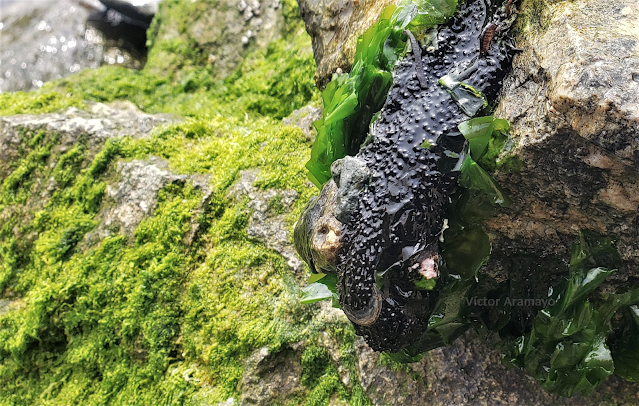


El gran problema de la contaminación por hidrocarburos (s.s. polución) es la persistencia del daño químico en el agua de mar y en los sedimentos (algo que lamentablemente no se soluciona sólo con la extracción física del petróleo acumulado en la orilla o aquel que flota en el agua). La mixtura de químicos presentes en el crudo se degradará a diferentes tiempos, pero mientras eso ocurre puede inducir hipoxia/anoxia permanente sobre el fondo (y dependiendo del tiempo de residencia del polutante, casi siempre se forma una capa negra, apelmazada, sobre la superficie del sedimento marino). Si sumamos la transmisión de este impacto hacia los demás niveles tróficos, el resultado es terrible. Prioridad para combatir esto: tecnología (la mejor que tengamos) y colaboración multidisciplinaria. Este problema no se resolverá pronto.
Ocypode gaudichaudii
Cancer sp.
Pagúrido
Echinolittorina peruviana
Patallus mollis (juvenil)
Patallus mollis (juvenil)
Oulactis concinnata
Chiton cumingsii
Caenocentrotus gibbosus
Perumytilus purpuratus
Anémonas juveniles
Allopetrolisthes angulosus
Subscribe to:
Posts (Atom)