Showing posts with label Marine soft sediments. Show all posts
Showing posts with label Marine soft sediments. Show all posts
Friday, September 6, 2024


Upcoming events: The 7th World Conference on Marine Biodiversity. November - 2026
The 7th World Conference on Marine Biodiversity will be organized in Bruges between November 17th and 20th 2026.
The World Conference on Marine Biodiversity series (WCMB) is conducted tri-annually. The WCMB is a high-level international meeting that focuses on the conservation and sustainable use of marine biodiversity. The conference provides a platform for policymakers, scientists, conservationists, industry representatives, and other stakeholders to discuss current and emerging marine biodiversity issues and identify ways to protect and sustainably manage marine ecosystems and their resources.
Previous editions were held in:
- Valencia, Spain (2008) - Outcome: Valencia Declaration - A Plea for the Protection of Marine Biodiversity
- Aberdeen, Scotland (2011) - "Our Oceans, Our Future"
- Qingdao, China (2014) - "Life in the Changing Ocean"
- Montreal, Canada (2018) - "Connecting with the Living Ocean"
- Auckland, New Zealand (2020) - "Understanding the current scale and importance of biodiversity in the marine environment"
- Penang, Malaysia (2023) - "Marine Biodiversity Challenges in the Anthropocene"

Saturday, February 3, 2024
Tuesday, November 1, 2022
Sunday, October 23, 2022
Monday, July 11, 2022
Respuestas del bentos marino frente a el Niño costero 2017 en la plataforma continental de Perú central (Callao, 12°S)
Se evaluó y comparó el comportamiento del bentos (en un amplio espectro de tamaños: macrofauna, meiofauna metazoaria, foraminíferos y bacterias heterótrofas gigantes) durante la evolución de El Niño Costero 2017 (ENC 2017), en base al análisis de muestras replicadas de sedimento (mediante draga y multisacatestigo), parámetros geoquímicos y oceanográficos del fondo, en tres estaciones (33, 94 y 178 m) localizadas frente a Callao (12°S). A pesar del fuerte calentamiento superficial observado y la anómala descarga de los ríos, el impacto de ENC 2017 sobre la distribución del oxígeno disuelto (OD), tanto en la columna de agua como cerca al fondo, no fue significativo; de hecho, la profundidad de la oxiclina se mantuvo cerca de la superficie (por encima de los 20 m, a 15 mn). Similarmente, la geoquímica del sedimento no exhibió cambios estacionales inusuales, por ejemplo, en la concentración de sulfuros (H2S, gradualmente más intenso con la profundidad). En la macrofauna (desde meses previos a ENC 2017), se observó un descenso progresivo en la abundancia del poliqueto espiónido Paraprionospio pinnata y, por el contrario, un aumento de Magelona phyllisae (en menor magnitud que P. pinnata). A diferencia de estos anélidos, tanto moluscos bivalvos del género Pitar como bacterias del género compuesto Candidatus Marithioploca fueron relativamente frecuentes (especialmente en las estaciones más someras). De igual forma, nemátodos de vida libre acompañantes de la macrofauna y particularmente integrantes de la meiofauna (e.g. Desmodora sp., Halalaimus sp., Dichromadorasp., Sabatieria sp.) fueron hallados recurrentemente durante todo el período de estudio. Los foraminíferos calcáreos dominaron en la mayor parte del estudio, en tanto que los foraminíferos de testa blanda (alogrómidos) y los aglutinados fueron importantes en los centímetros subsuperficiales y hacia la zona oceánica, respectivamente; esta comunidad no mostró mayores cambios en las tres estaciones estudiadas, aunque especies calcáreas como Bolivina seminuda y Buliminella tenuata tuvieron una mayor contribución en la estación intermedia (94 m). En contraste a otros eventos, la débil o inexistente profundización de la oxiclina frente a Callao durante ENC 2017, no perturbó las condiciones disóxicas habituales del bentos en la costa central peruana (e.g. OD < 0,1/0,5 mL.L-1). En este contexto, nuestro trabajo ilustra una respuesta poco conocida en relación con eventos El Niño, de acuerdo con su origen, evolución y alcance.


Abundancia meiofaunal en sedimentos arenosos de una bahía somera, consta central peruana
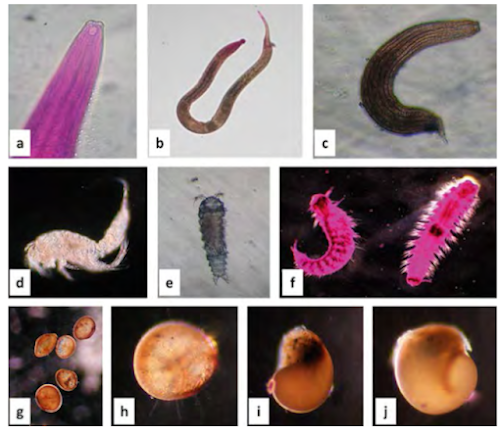
Aunque tenemos alguna información acerca de la meiofauna de fondos fangosos en Perú, aún se desconocen las características de esta comunidad en fondos arenosos. Se presenta una descripción y análisis comunitario muy básico de la meiofauna en sedimentos superficiales de la bahía de Miraflores y el área marina de Carpayo. Mediante el empleo de un nucleador tipo HAPS se recolectaron muestras replicadas de sedimento. La identificación taxonómica mostró 15 taxa, con tendencia hacia mayor riqueza en estaciones más profundas. En la estación más profunda se observó mayor número de familias de nemátodos de vida libre y de especies de poliquetos (tanto en etapas larvales como juveniles, especialmente Magelona phyllisae). También se identificaron copépodos de los Órdenes taxonómicos Harpacticoida y Poecilostomatoida. Las densidades (0-5 cm) fluctuaron entre 25 ± 18 y 438 ± 234 Ind/10 cm2. Familias de nemátodos como Monhysteridae (167 ± 123 Ind/10 cm2), Chromadoridae (110 ± 95 Ind/10 cm2), Desmodoridae (70 ± 34 Ind/10 cm2) fueron numéricamente dominantes. El análisis de agrupamiento muestra clara asociación en las estaciones dominadas por nemátodos. La mayor parte de los organismos bentónicos estuvieron poblando la capa superficial del sedimento (0-1 cm), pero sólo los nemátodos exhibieron penetración vertical más homogénea. Algo similar se observó en moluscos (bivalvos y gastrópodos) en los centímetros subsuperficiales (4-5 cm). Se discute la relevancia de estos primeros avances en cuanto a la estructura comunitaria meiofaunal de estos hábitats y su potencial utilidad para entender las señales de reclutamiento in situ de especies bentónicas
Puedes leer el artículo aquí
Sunday, January 30, 2022
Derrame de petróleo en Perú central [23.1.2022]
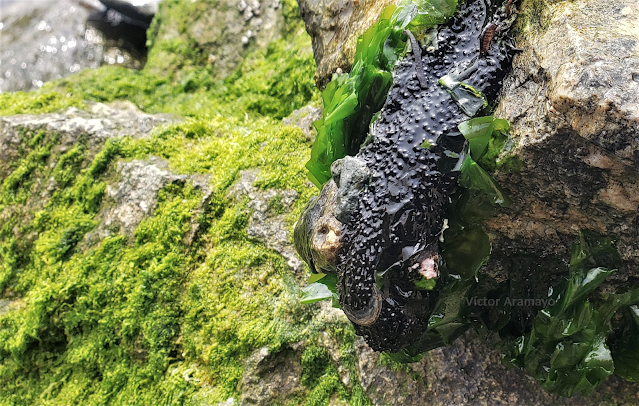
¿Qué está pasando en algunas pequeñas playas cerradas y protegidas que tiene Ancón? Ayer vimos algo de eso. A diferencia de algunas playas abiertas de Ventanilla y el propio Ancón, devastadas por el petróleo derramado, impulsado por las corrientes que lo transportan, hay algunos pocos sitios que no muestran a simple vista el daño ecológico. Debido a la morfología del borde costero, la fauna que habita estos lugares parece resistir un poco más y mejor este grave impacto (algunas fotografías y un vídeo de muestra). Sin embargo, la realidad es que apesar de estar protegidas en pequeños senos del borde costero, será cuestión de tiempo para que el impacto químico llegue a estas poblaciones.
El gran problema de la contaminación por hidrocarburos (s.s. polución) es la persistencia del daño químico en el agua de mar y en los sedimentos (algo que lamentablemente no se soluciona sólo con la extracción física del petróleo acumulado en la orilla o aquel que flota en el agua). La mixtura de químicos presentes en el crudo se degradará a diferentes tiempos, pero mientras eso ocurre puede inducir hipoxia/anoxia permanente sobre el fondo (y dependiendo del tiempo de residencia del polutante, casi siempre se forma una capa negra, apelmazada, sobre la superficie del sedimento marino). Si sumamos la transmisión de este impacto hacia los demás niveles tróficos, el resultado es terrible. Prioridad para combatir esto: tecnología (la mejor que tengamos) y colaboración multidisciplinaria. Este problema no se resolverá pronto.




El gran problema de la contaminación por hidrocarburos (s.s. polución) es la persistencia del daño químico en el agua de mar y en los sedimentos (algo que lamentablemente no se soluciona sólo con la extracción física del petróleo acumulado en la orilla o aquel que flota en el agua). La mixtura de químicos presentes en el crudo se degradará a diferentes tiempos, pero mientras eso ocurre puede inducir hipoxia/anoxia permanente sobre el fondo (y dependiendo del tiempo de residencia del polutante, casi siempre se forma una capa negra, apelmazada, sobre la superficie del sedimento marino). Si sumamos la transmisión de este impacto hacia los demás niveles tróficos, el resultado es terrible. Prioridad para combatir esto: tecnología (la mejor que tengamos) y colaboración multidisciplinaria. Este problema no se resolverá pronto.
Ocypode gaudichaudii
Cancer sp.
Pagúrido
Echinolittorina peruviana
Patallus mollis (juvenil)
Patallus mollis (juvenil)
Oulactis concinnata
Chiton cumingsii
Caenocentrotus gibbosus
Perumytilus purpuratus
Anémonas juveniles
Allopetrolisthes angulosus
Monday, September 20, 2021
Desmodora (Nematoda) from central Peru
Cephalic region of one of the most common free-living nematode inhabiting surface (reduced) sediments, central Peru
https://www.youtube.com/channel/UCuDB7fCruCfyjl2GLTpBVhA
Monday, February 1, 2021
Sunday, November 22, 2020
Identification of Copepoda
Check out an interview I did with my friend Dr. Nancy Mercado-Salas on her fascination with tiny copepods, why it is so interesting to look at them morphologically and genetically, and why research cruises are so awesome :) https://t.co/3Ffmw5RkV9
— Eva Paulus (@Deep_Sea_Dirndl) November 3, 2020
Sunday, May 31, 2020
Phylum Gastrotricha.
Seguimos con el hilo! Ejemplar del Phylum Gastrotricha. 400X. Ejemplar obtenido en una muestra de agua dulce, de un acuario de agua caliente (~24ºC). Inofensivo para el resto de inquilinos 👨🏽🔬 pic.twitter.com/xR2IR6W4FQ
— Tony (@TonySiscar) May 21, 2020
Thursday, April 9, 2020


Wednesday, April 1, 2020
Subscribe to:
Posts (Atom)