Wednesday, January 5, 2011

Upcoming event: World Conference on Marine Biodiversity, September 2011, Scotland (UK)

See more on official web site

ASLO, Aquatic Sciences Meeting, February 2011


Special Sessions List 

S09: Benthic Biogeochemical Processes: From microscale patchiness to ecosystem function [Schedule]

S27: Interactions Between Aquatic Microbial Eukaryotes: Intracellular to Community Processes [Schedule]

S45. Protists in Extreme Environments: Beyond Diversity  [Schedule]

S62: Microbial Adaptation to Environmental Changes and Advances in Marine Microbial Diversity and Dynamics in Latin America and the Caribbean [Schedule]

S67: Deep-Sea Corals and Other Communities Associated with Hydrocarbon Seeps and Polymetallic Sulfide Deposits: Life in the crosshairs of human impact [Schedule]


See complete list on : The Humboldt Current System web site


Thursday, December 9, 2010

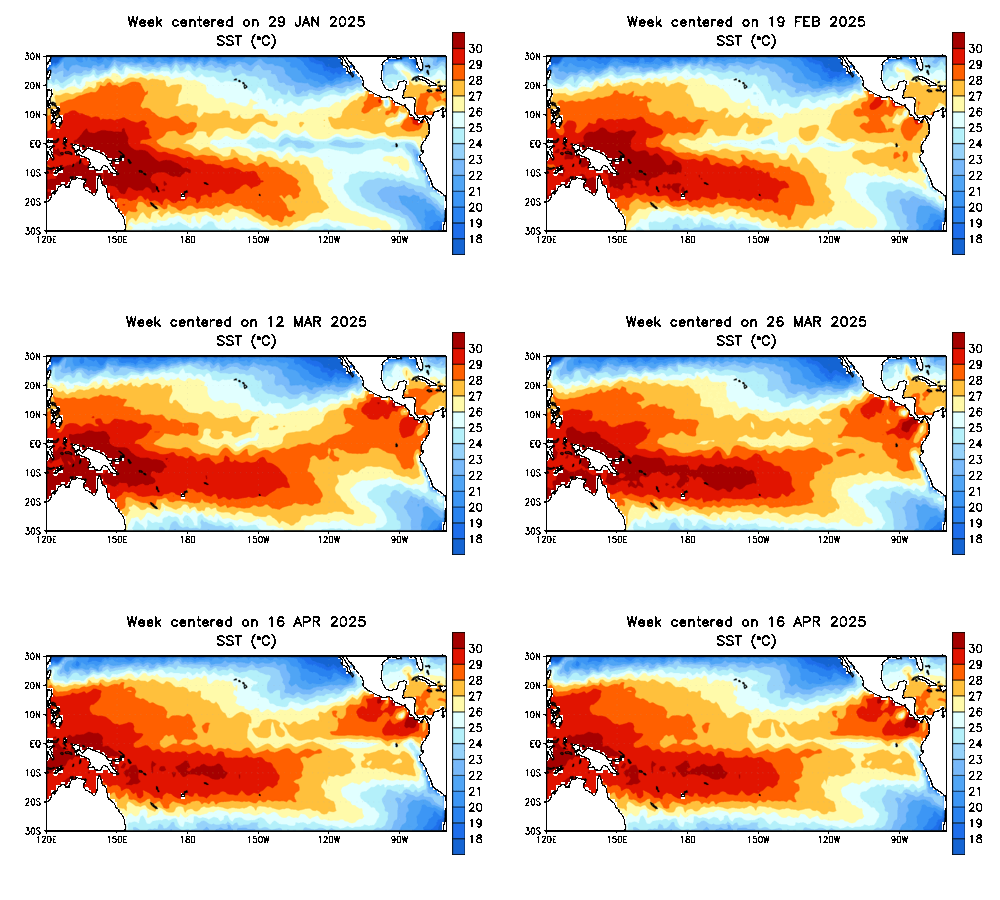
ENSO across eastern tropical Pacific


Weekly averaged sea surface temperatures (top, °C) and anomalies (bottom, °C) for the past twelve weeks. SST analysis is the optimum interpolation (OI) analysis, while anomalies are departures from the adjusted OI climatology (Reynolds and Smith 1995, J. Climate, 8, 1571-1583).


Lo último sobre el ENOS
Fuente: NOAA (http://www.cpc.ncep.noaa.gov)

Monday, December 6, 2010

BENTHIC ECOLOGY MEETING 2011


March 16-20, 2011
Renaissance Riverview Plaza and Battle House Hotel

Key dates: Early Registration Deadline, February 1, 2011
Hotel Reservation by February 12, 2011.
Abstract Submission Deadline, January 21, 2011.


The 2nd "Beneath the Waves Film Festival" will be held at the Benthic Ecology Meeting, For more information please visit
www.beneathwavesff.wordpress.com
Organizers:  Sean Powers, John Valentine and Kenneth Heck
Dauphin Island Sea Lab and the University of South Alabama


The 2011 Benthic Ecology Meeting will accept abstracts for oral presentations on the following topics:

Chemical Ecology
Fisheries
Physical Processes
Behavior
Physiological and Molecular Ecology
Macroecology
Introduced species
Life History Strategies
Recruitment/Larval Ecology
Restoration
Evolution
Conservation
Trophic Relationships
Community Ecology
Biodiversity
Ecosystem Functioning
Parasite-Host Relationships
Anthropogenic Impacts
Oil Spill Impacts

The deadline to submit abstracts for oral and poster presentations at the 2011 BEM will be January 21, 2011 at 5:00 PM CST.

Abstract Guidelines
Please follow these instructions carefully.  Abstracts must be in English, use metric units, and italics for scientific name.  Do not include illustrations, figures, or photos.

Oral presentations will be 15 minutes (approximately 12 minutes with 3 minutes for questions) and strictly adhered to.  Microsoft Powerpoint (version 2007) will be used and it is suggested that all videos be in the format of .avi, .mpg, or wmv.  Note that all presentations will be given on supplied windows xp laptops.  Personal laptops will not be allowed for presenting presentations. Presentations should be uploaded at registration or during breaks on the day before your scheduled presentation time. A practice room will be available.

Please Click Here to submit your abstract
For information on submitting a film, please visit www.beneathwavesff.wordpress.com or contact Austin Gallagher.
 
DISL                   USA


Mais informações no site oficial


Thursday, November 25, 2010

3er Congresso Brasileiro de Biologia Marinha / Maio 2011


Centro de Convenções
do Hotel Praiamar

Natal - RN 

cbbm2011@gmail.com       
Fone/fax: (21) 2629-2307    


More information HERE

Monday, November 22, 2010

2nd International Congress on Invertebrate Morphology, June 20-23, 2011


Welcome to the 2nd International Congress on Invertebrate Morphology (ICIM), the venue that interconnects researchers from the International Society for Invertebrate Morphology and other societies interested in the morphology and evolution of invertebrate animals. The 2nd ICIM will be hosted by the Museum of Comparative Zoology, the Department of Organismic and Evolutionary Biology, and the Harvard Museum of Natural History, at Harvard University, from June 20th to June 23rd 2011.
 More information HERE


Wednesday, October 27, 2010

Cirratulidae & Spionidae Identification Workshop 26th to 28th November 2010 in Bath


This course will enable participants to gain experience and develop confidence in the identification of species of Spionidae and Cirratulidae, two common families of marine annelids. The course will include an introductory talk on each of the groups covering body parts, terminology and use of the important dichotomous keys for each group. The main focus of the weekend will be microscope work, allowing students to work through specimens from the two families at their own speed. Participants will carry out identification using industry standard keys and papers with the assistance of two professional marine biologists who between them have over fifteen years experience of processing benthic samples. Specimens from the majority of British genera will be available. Time will be allocated at the end of the course for participants to look at their own specimens with assistance from the course leaders.
Course fees include membership to the Marine Biological Association of the UK.  Existing members of the Marine Biological Association are entitled to a 10% discount on the rate.

Download 26th to 28th November 2010 booking form here


Introduction to Benthic Taxonomy
A two week course to be held at the Marine Biological Association in Plymouth. This course is aimed at undergraduates and recent graduates wishing to develop their benthic identification skills. The course will ;

    * introduce students to  the concepts and uses of benthic taxonomy
    * provide experience of both intertidal and subtidal sample collection, preservation and analysis
    * provide training in the use and construction of dichotomous keys (including online resources)
    * develop taxonomic understanding and exposure


 Specialist Taxonomy Short Courses
Short courses concentrating on particular phyla, families or interest groups. These courses are aimed at graduates and practising taxonomists wishing to enhance their knowledge of marine taxonomy.  Demonstrable experience in marine taxonomy or completion of the Introduction to Marine Taxonomy is a prerequisite to these courses. You will only be awarded a place on a particular course if we are happy that you have the required  prior knowledge.

Download this document for further details


More information: http://www.seasurvey.co.uk/

Tuesday, October 19, 2010

Friday Harbor Laboratories SUMMER 2011 COURSEWORK

Applications for Summer 2011 courses will be accepted starting in October, 2010 until the following deadline:
FEBRUARY 1st APPLICATION DEADLINE*
*Applications will be accepted past the deadline if space available. For information please contact Stacy Markman, FHL Student Coordinator.

FHL SUMMER A TERM: June 20-July 22 (5 weeks)
Students arrive Sunday, June 19 after 3:00 p.m., depart Friday, July 22 after lunch.

FHL SUMMER B TERM: July 25-August 26 (5 weeks)
Students arrive Sunday, July 24 after 3:00 p.m., depart Friday, August 26 after lunch.

Summer classes held Monday-Saturday:
Mon-Fri 8 am-5 pm, plus Sat morning 8 am-noon, except final week no Saturday meeting.
The 5-week courses in summer are intended primarily for graduate students, with the exception of Marine Invertebrate Zoology. Courses may be taken sequentially, i.e., one in each summer session, but not concurrently. Well-qualified undergraduates may be admitted to graduate level courses with the consent of the FHL Director and the faculty involved.
In Summer 2011 FHL is offering one undergraduate-level course and five graduate-level courses. Each course is 9 credits.


More details and further information on web site

Friday, September 3, 2010

Vacancy: Senior Marine Macrobenthic Taxonomist


(From Annelida group)
Dear Colleagues,
 

We have the following vacancy at Marine Ecological Surveys Ltd (MESL).

Deadline for applications has already expired, but we would be happy to consider further applications until the 15th of September 2010.

Kind regards,
Sara Marzialetti

Vacancy: Senior Marine Macrobenthic Taxonomist
The MESL laboratory specialises in analysis of benthic and epibenthic samples from a wide variety of environments ranging from estuarine to offshore.  Primarily our work consists of monitoring for the aggregate industry and, more recently, the renewable energy sector.  Our staff comprise of an experienced team of marine biologists who are self-motivated and work to tight deadlines.
We are looking for a senior marine macrobenthic taxonomist whose primary role will be to undertake analysis of benthic samples and identification of all taxonomic groups, together with training of junior staff in benthic taxonomy.  You will be educated to at least degree level in marine biology or a related discipline and also have at least two years experience in marine invertebrate analysis and taxonomic identification.  While you will be mostly lab-based, you will also be required to participate in fieldwork.  
MESL participates in the NMBAQC scheme, and in conjunction with this, we run our own internal training scheme to develop the taxonomic skills of our laboratory staff.  We also encourage continued professional development for all our staff.
Please email your CV to lab@seasurvey.co.uk
--
Sara Marzialetti PhD
Senior Marine Ecologist

Marine Ecological Surveys Limited
3 Palace Yard Mews
Bath
BA1 2NH

Tel: 01225 442211
Fax: 01225 444411

Email: sara@seasurvey.co.uk
Web:    www.seasurvey.co.uk
 

Tuesday, August 24, 2010

I Simposio de Biodiversidad Marina y Costera de Latinoamerica y El Caribe


                          Del 9 al 12 de diciembre del 2010
                                             Manta – EcuadorManta – Ecuador

More information HERE

Monday, August 23, 2010

More Publications

The ISME Journal advance online publication 15 July 2010; doi: 10.1038/ismej.2010.106

Big sulfur bacteria

Bo Barker Jørgensen1
1Department of Biological Sciences, Center for Geomicrobiology, Aarhus University, Aarhus, Denmark
Correspondence: BB Jørgensen, E-mail: bo.barker@biology.au.dk

Donwload here


***********************************************************
The ISME Journal , (5 August 2010) doi:10.1038/ismej.2010.121

Identity of epibiotic bacteria on symbiontid euglenozoans in O2-depleted marine sediments: evidence for symbiont and host co-evolution

V P Edgcomb, S A Breglia, N Yubuki, D Beaudoin, D J Patterson, B S Leander and J M Bernhard

Abstract
A distinct subgroup of euglenozoans, referred to as the ‘Symbiontida,’ has been described from oxygen-depleted and sulfidic marine environments. By definition, all members of this group carry epibionts that are intimately associated with underlying mitochondrion-derived organelles beneath the surface of the hosts. We have used molecular phylogenetic and ultrastructural evidence to identify the rod-shaped epibionts of the two members of this group, Calkinsia aureus and B.bacati, hand-picked from the sediments of two separate oxygen-depleted, sulfidic environments. We identify their epibionts as closely related sulfur or sulfide-oxidizing members of the epsilon proteobacteria. The epsilon proteobacteria generally have a significant role in deep-sea habitats as primary colonizers, primary producers and/or in symbiotic associations. The epibionts likely fulfill a role in detoxifying the immediate surrounding environment for these two different hosts. The nearly identical rod-shaped epibionts on these two symbiontid hosts provides evidence for a co-evolutionary history between these two sets of partners. This hypothesis is supported by congruent tree topologies inferred from 18S and 16S rDNA from the hosts and bacterial epibionts, respectively. The eukaryotic hosts likely serve as a motile substrate that delivers the epibionts to the ideal locations with respect to the oxic/anoxic interface, whereby their growth rates can be maximized, perhaps also allowing the host to cultivate a food source. Because symbiontid isolates and additional small subunit rDNA gene sequences from this clade have now been recovered from many locations worldwide, the Symbiontida are likely more widespread and diverse than presently known.

Recent Publications On Meiofauna

The ISME Journal , (13 May 2010)

doi:10.1038/ismej.2010.63
 
Meiofauna reduces bacterial mineralization of naphthalene in marine sediment

Johan Näslund, Francisco JA Nascimento and Jonas S Gunnarsson


Abstract
The role of sediment-living meiofauna, benthic invertebrates smaller than 1000 μm such as nematodes and ostracods, on the mineralization of naphthalene, a common polycyclic aromatic hydrocarbon (PAH) in marine sediments, was studied in microcosms using radiorespirometry. A method to extract live meiofauna was developed and used in order to experimentally manipulate meiofauna abundance and group diversity. Higher abundances of meiofauna were found to significantly decrease naphthalene mineralization. Furthermore, a change in the bacterial community composition (studied using terminal restriction fragment length polymorphism) was also observed in presence of higher meiofauna abundance, as well as a lower number of cultivable naphthalene-degrading bacteria. The reduced mineralization of naphthalene and the altered bacterial community composition in the presence of increased meiofauna abundance is likely the result of top-down control by meiofauna. This study shows that higher abundances of meiofauna can significantly decrease the microbial mineralization of PAHs such as naphthalene and also significantly modify the bacterial community composition in natural marine sediments.